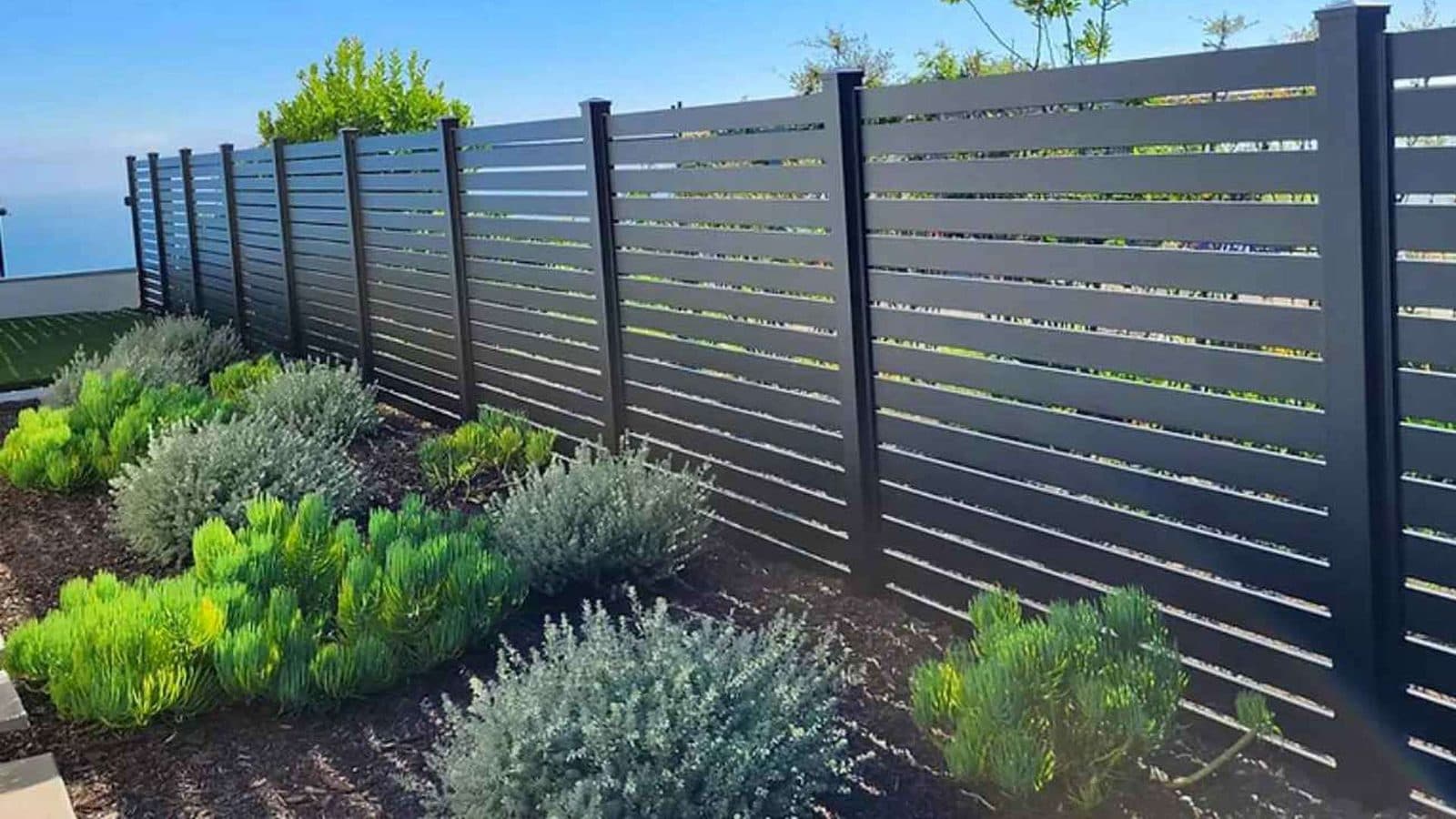
A front fence is the only part of your fencing anyone else ever looks at. It sets the face of the house, it decides whether the yard is usable with a dog or a toddler in it, and it is the one run where height, sight lines and council rules all meet. It is also the run people get wrong most often, usually because they are working from a height limit that does not exist. This guide covers what is actually allowed on a Brisbane frontage, which profile suits which street, and what the whole thing costs.
The quick answer
There is no blanket 1.2m front fence limit in Brisbane. A domestic fence up to 2m is generally accepted development, front boundary included.
The exceptions are real: character and heritage overlays, corner sight triangles (1m maximum), retaining walls that add to the height, and private estate covenants.
1200mm suits an open, presentable frontage; 1800mm suits privacy where the house sits close to the street.
A front fence faces the road, so it is not a dividing fence and the cost is yours alone. Only the return along the side boundary is shared.
The 1.2 metre limit that does not exist
Almost every front fence conversation starts with a number someone half remembers: 1.2 metres, sometimes 1.5. It is worth saying plainly, because it changes what you can build. There is no blanket front fence height limit in Brisbane. Under the Queensland Development Code a domestic fence up to 2m is generally accepted development, and Brisbane City Council applies the same threshold on the front boundary as it does on the back: building approval is triggered once a fence tops 2m above natural ground level.
Our full breakdown of fence height rules in Queensland covers the thresholds council by council across South East Queensland. The short version for a front boundary is that 1800mm, the height most people actually want, sits comfortably under the line.
Where the myth comes from
Three real rules get flattened into one imaginary one. Corner blocks genuinely are capped near the corner. Character and heritage overlays genuinely do control front fence height and transparency. And new estates often carry a developer covenant with a lower limit. None of those is a citywide 1.2m rule, but if any of them applies to your lot it will feel like one.
Where the extra rules actually bite
Four things move a front boundary out of the simple case. Check them in this order, because the first one that applies is the one that sets your height.
| What applies | Effect on the front fence | Where to check |
|---|---|---|
| Corner sight triangle | Any structure capped at about 1m inside the truncation at the corner, open or solid | Queensland Development Code, and your council |
| Character or heritage overlay | Height and transparency controls, and the look is assessed as well as the height | Your council’s planning scheme and property report |
| Retaining wall under the fence | Height is measured as the combined total, so a 1.2m wall plus a 1.2m fence is over the line | Building certifier |
| Estate covenant | A private contract with the developer, often stricter than council on height and material | Your land contract, not the planning scheme |
Corner blocks are the one people trip over most, because the cap applies to the sight triangle rather than the whole frontage. Our guide to corner block fence rules in Queensland sets out how the truncation is drawn and how to step a fence down through it without the run looking accidental.
If the house is in a character area, the fence is judged on appearance as well as height. That is a different design brief, and we have covered it separately in front fences for character homes. Where a retaining wall is involved, the combined measurement is the one that counts, and fencing on a retaining wall explains how that total is worked out. An easement across the front of the block is a separate check again.
Open or private: the decision that sets the look
A back fence has one job, which is privacy. A front fence has three that pull against each other: it has to present the house, keep the yard usable, and let you see out. That is why the answer on the front boundary is so often different from the answer at the rear.
At 1200mm with an open profile, the fence reads as a boundary rather than a barrier. You keep the outlook from the verandah, the street keeps casual surveillance of your yard, and the house still presents to the road. It will hold a dog and keep a small child in the yard, which for most frontages is the actual requirement.
At 1800mm with a tight slat infill, you get genuine privacy, and it is the right call where the house sits close to the footpath or the frontage faces a busy road. The trade is that a long solid run on a suburban street can look defensive, and it takes the frontage out of view from the street entirely. If you go this way, our guide to privacy fence slat spacing covers how tight the gaps need to be to actually screen, which is closer than most people expect.
The pattern that works most often on a Brisbane block is a mixed run: an open profile across the frontage where presentation matters, and a taller solid slat run down the private side and across the back. In the same powder-coat colour the transition reads as deliberate rather than as two different fences.
The three profiles on a frontage
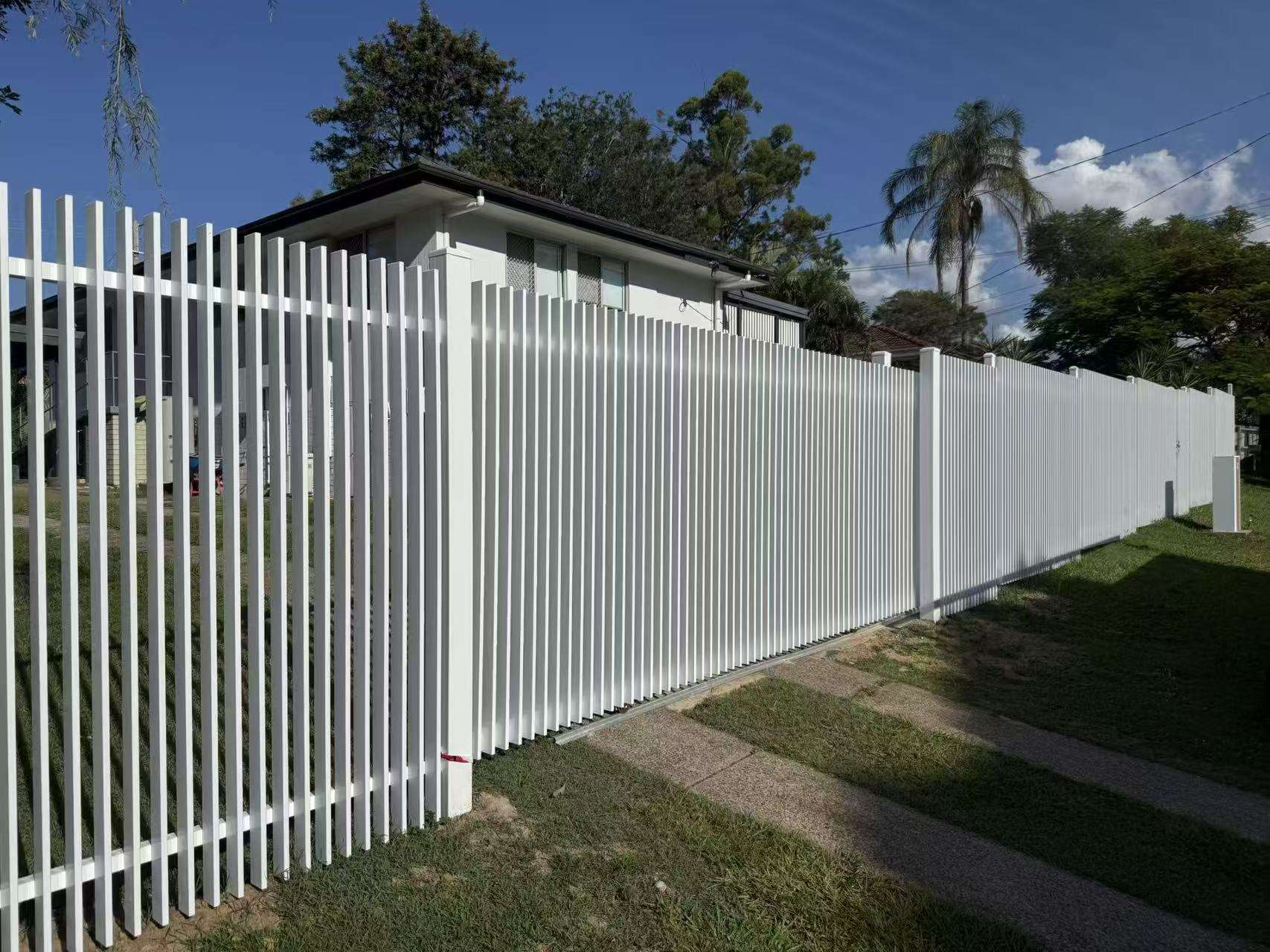
We make three fence profiles, all in powder-coated aluminium, all made to order, and all available in either of the two standard heights. On a front boundary they read quite differently from the footpath.
| Profile | How it reads from the street | Panel sizes | From |
|---|---|---|---|
| Horizontal slat | Contemporary, horizontal lines, reads as a solid band as the gaps tighten | 2400 x 1200mm or 2400 x 1800mm | $279 a panel |
| Vertical picket | Classic and open, suits older and traditional frontages | 2350 x 1200mm or 2350 x 1800mm | $368 a panel |
| Welded vertical blade | Sharp modern lines, welded frame, the most substantial of the three | 2400 x 1200mm or 2400 x 1800mm | $399 a panel |
The full comparison, including how each profile behaves on a slope, is in our guide to aluminium fence styles, and the exact panel dimensions and height options are set out in aluminium fence panel sizes and heights.
Colour matters more on a frontage than anywhere else on the block, because it is the part people see against the house rather than against the garden. We powder coat in Black, Monument and White, and choosing an aluminium fence colour covers how each one sits against common Brisbane rooflines and brick.
Gates, and the part people leave until last
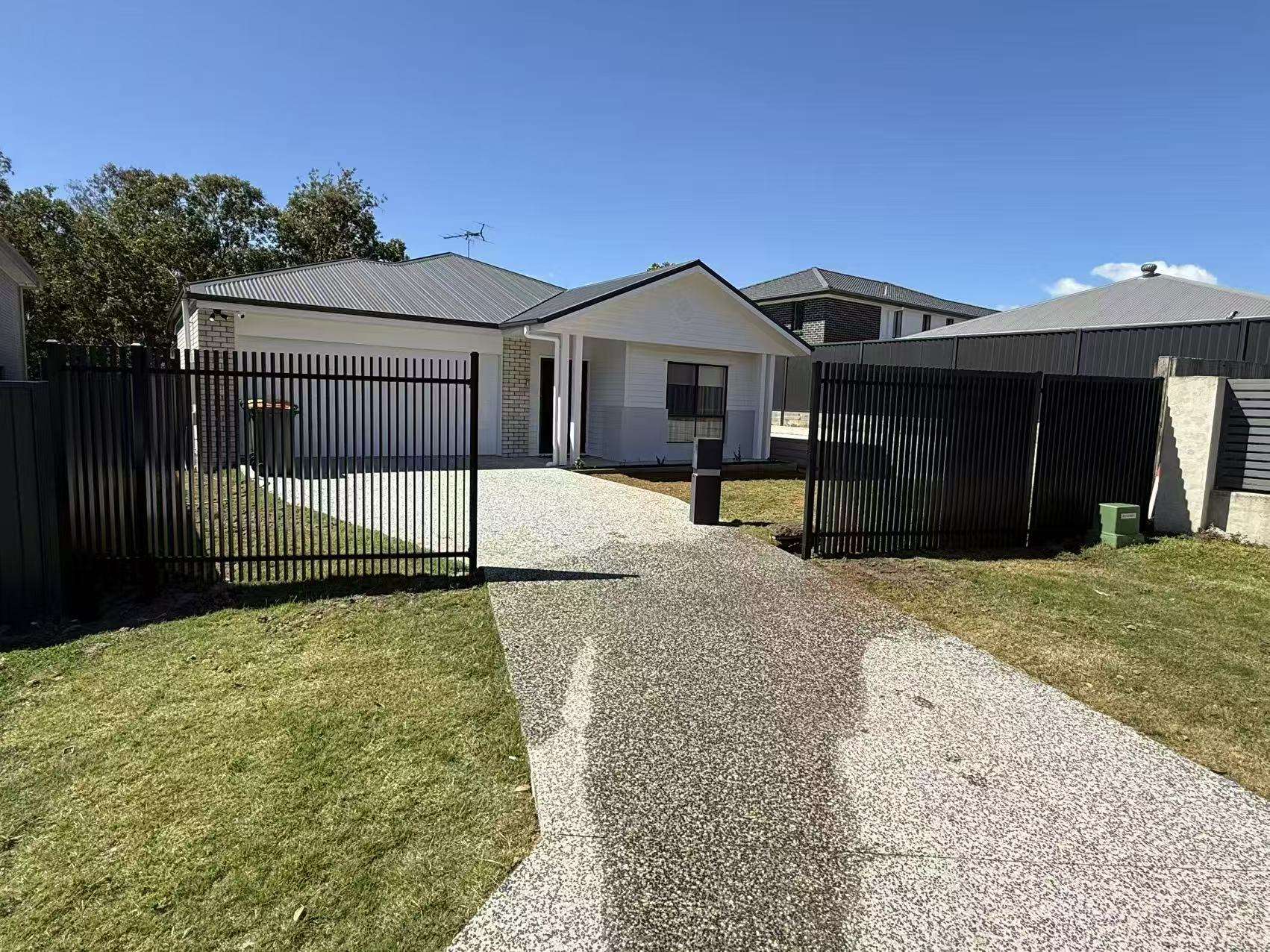
A frontage usually needs two openings, and they are ordered as separate items. The pedestrian gate is the one you use daily, and the standard leaf is 1000mm wide, which is deliberately sized to take a wheelie bin, a mower or a wheelbarrow without a fight. Sizes, posts and what comes in the kit are covered in our guide to aluminium pedestrian gates.
The vehicle opening is the one to plan early, because it changes the post layout for the whole frontage. A gate can slide along the inside of the fence or swing as a double leaf, and each needs different room. Before you settle on a style, work through how to measure your driveway for a gate, which covers the clear opening, the slope and the space you need beside and behind. The driveway gate range lists the made to order widths and heights.
Measure the crossover, not the driveway
The opening a gate has to span is the gap between the two posts at the boundary, which is usually wider than the concrete of your driveway. Measure between the fixed points the gate will actually hang from, and tell us what is on each side: post, brick pier, or nothing yet.
What a front fence costs
A frontage is short, which is why a front fence is usually the cheapest run on the block in total and the most expensive per metre once the gates are in. Working from the panel prices above and the panel widths we make, the fence itself lands roughly here.
| Profile | Panel | Panel width | Fence only, per metre |
|---|---|---|---|
| Horizontal slat | $279 | 2400mm | about $116 |
| Vertical picket | $368 | 2350mm | about $157 |
| Welded vertical blade | $399 | 2400mm | about $166 |
Posts are a separate line and you need one roughly every panel. A 65 x 65 x 2400mm in-ground post is $61.99, which adds around $26 a metre, plus $5 a post cap and $15 a set of panel brackets. Heavier 100 x 100mm posts are used where a gate hangs. That is the supply side; for the full picture including delivery and the difference a slope makes, see how much aluminium fencing costs in Brisbane.
If you want it installed rather than supplied, the labour sits on top and varies with access, ground and how many gates are in the run. Supply-only against supply-and-install sets out what each one includes, and either way you can talk to us about the whole frontage as one quote.
Who actually pays for it
This catches people out at quote stage. A dividing fence sits on the common boundary between two properties, and the cost of a sufficient one can be shared with the neighbour. A front fence faces the road, which is not a neighbour, so it falls outside that arrangement entirely and the cost is yours.
The exception is the short return where the fence turns the corner and runs along the side boundary. That section is a dividing fence, and it can be shared. We have set the whole thing out, including corner blocks and what to do about the boundary line itself, in who pays for a front fence in Queensland.
Bins, letterbox and the mower
The practical details are what make a frontage work day to day, and they are cheap to get right at the planning stage and expensive to fix afterwards.
Bin access. A 1000mm pedestrian gate clears a wheelie bin comfortably. If the only way out is through the vehicle gate, you will be opening it twice a week.
Letterbox. It has to be reachable from the footpath without opening anything. Build it into the fence line or set it beside the pedestrian gate, not behind it.
Mowing strip. Aluminium does not rot, so the panel can sit close to the ground, but leaving a consistent gap or a concrete strip underneath saves whipper snipping against the powder coat every fortnight.
Slope. Frontages fall towards the kerb more often than not. Panels can be stepped or raked to follow it, and the choice changes how the top line reads from the street.
Services. Water meters, and sometimes a pit or a pillar, sit in or near the front boundary and have to stay accessible. Mark them before the post holes are set out.
Frequently asked questions
How high can a front fence be in Brisbane?
Generally up to 2m without building approval, the same threshold that applies to any domestic fence. Approval is triggered above 2m above natural ground level. The common exceptions are corner sight triangles, character and heritage overlays, and fences on top of retaining walls where the combined height is what gets measured.
Is there a 1.2m limit on front fences?
Not as a blanket Brisbane rule, and that is the single most common misconception about front boundaries. A 1m cap does apply inside the sight triangle on a corner block, and overlays and estate covenants can impose their own lower limits, but none of those applies to every lot.
Do I need council approval for a front fence?
Not for a standard fence up to 2m on most blocks. You will need it above 2m, where the fence sits on a retaining wall and the combined height tops 2m, or where an overlay applies. A building certifier is the right person to confirm it for your lot.
Can I put a solid 1800mm fence across my front boundary?
On most blocks the height itself is fine, since 1800mm is under the 2m threshold. Whether it is the right call is a design question. It gives real privacy where the house is close to the street, and it can look closed off on a suburban frontage where every other house is open.
Does my neighbour have to pay half of my front fence?
No. Cost sharing under the dividing fences legislation applies to fences on a common boundary between two properties. A fence facing the road is not a dividing fence. The short return along the side boundary is the part that can be shared.
Which profile is the cheapest for a front fence?
Horizontal slat, at $279 a panel for a 2400mm wide panel, which works out around $116 a metre for the fence itself before posts. Vertical picket and welded blade cost more per metre and read differently from the street, so it is worth deciding on the look first and the price second.
Can a front fence follow a sloping frontage?
Yes. Panels are made to order, so a run can be stepped in even increments or raked to follow the ground. Frontages that fall towards the kerb are normal in Brisbane. Send a photo from the footpath along with the measurements and we will tell you which suits the fall you have.
General guidance only, based on the Queensland Development Code and the published council thresholds current at the time of writing. Overlays, covenants, corner truncations and retaining walls all change the answer for an individual lot. Confirm with your council or a building certifier before you order.
Working out what your fence line needs? Tell us the run and the height and we will quote it, supply-only or installed.
- Brisbane-based supplier
- Aluminium fencing & gates
- Supply or installed