Most people know there is a law in Queensland about splitting fence costs with the neighbour, and most people assume it covers the whole job. It does not. The legislation is about dividing fences, and a fence across the front of your block is not one. That single distinction decides who pays for what, which part of the run you can raise with next door, and why a corner block costs more to fence than the one beside it. This is how the line is drawn.
The quick answer
A fence between your land and the road is not a dividing fence, so the cost sharing rules do not apply. You pay for the frontage.
The return, where the fence turns and runs along the common boundary with the neighbour, is a dividing fence and can be shared.
On a corner block both street frontages are yours alone, which is why corner lots cost more to fence.
Sharing is limited to a sufficient fence. If you want better than that, you pay the difference.
What a dividing fence actually is
The Neighbourhood Disputes (Dividing Fences and Trees) Act 2011 is the law people are thinking of when they say the neighbour pays half. It works on a specific thing: a fence on the common boundary between two parcels of land in separate ownership. Both sides benefit from it, so both sides contribute to a sufficient one.
Your front boundary does not meet that description. On the other side of it is a road, and a road is not an adjoining owner’s parcel. There is no second beneficiary to send a notice to. So the machinery in the Act, including the notice to contribute and the right to recover half the cost, simply has nothing to attach to. The frontage is yours, and so is the bill.
This is not a loophole or a council quirk, it is the basic design of the legislation. If you want the detail of how sharing works where it does apply, our guide to the notice to contribute for a dividing fence walks through the process and the forms.
Where the front fence stops and the dividing fence starts
Almost no front fence is only a front fence. It runs along the street boundary, then turns a corner at each end and runs a short distance back along the side boundaries to meet the existing side fence or the house. Those two short runs are the returns, and they change character the moment they leave the street boundary.
Along the frontage the fence faces the road and you pay. From the corner back, the fence sits on the common boundary with next door, which makes it a dividing fence like any other, and it can be shared on the usual terms. On a typical suburban block the frontage might be 15 to 18 metres and each return a metre or two, so the shared portion is small, but it is real and it is worth identifying before you order.
Ask for the quote split
Get the frontage and the returns priced as separate lines. It costs nothing to ask, it makes the conversation with the neighbour concrete rather than a percentage argument, and if you ever do need to serve a notice, the figure you are claiming is already itemised.
The fence has to be on your land
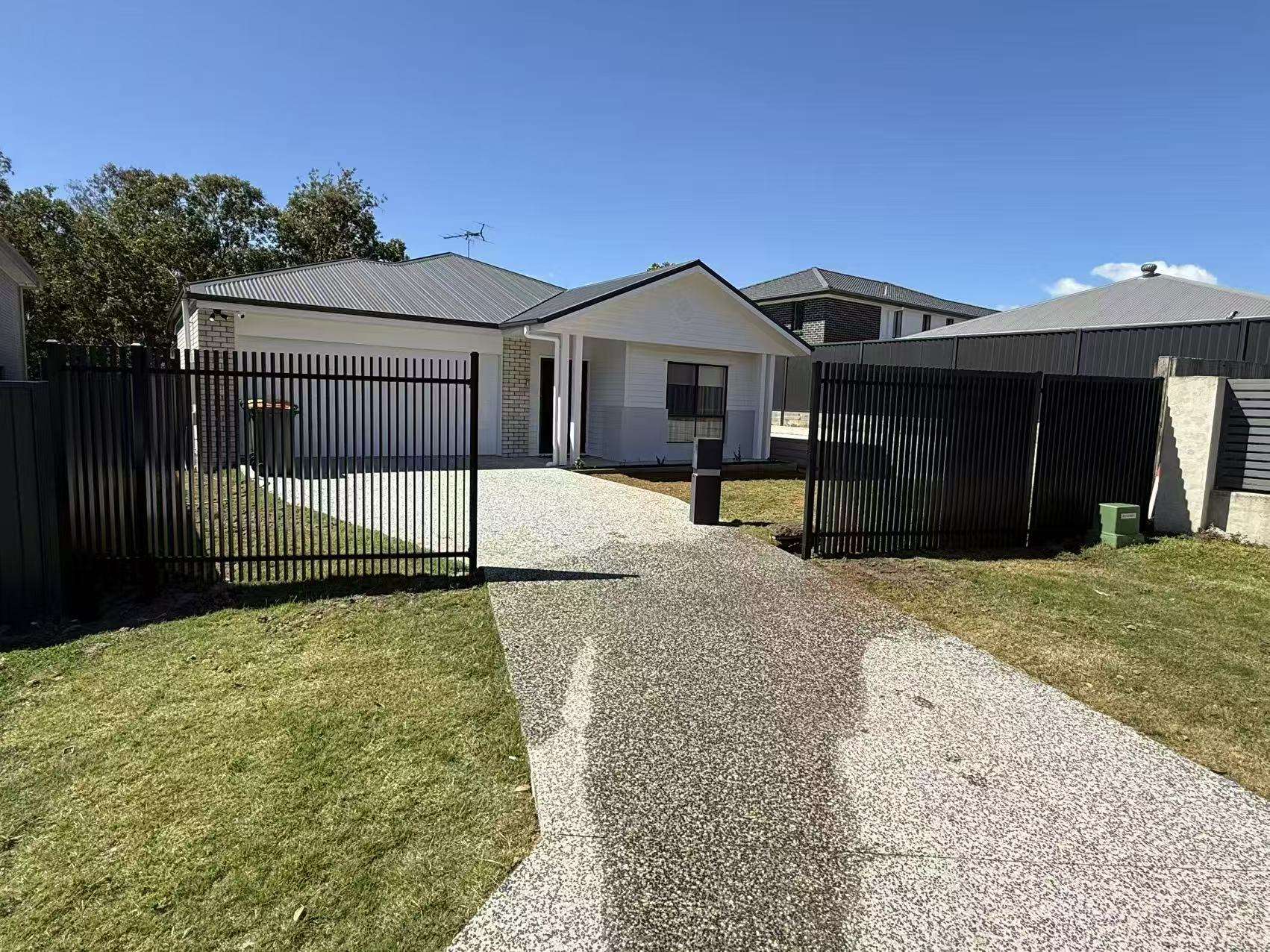
Before any of the cost question matters, the fence has to be in the right place. The front boundary of your lot is very often not where people assume it is. Council road reserve frequently extends past the kerb and across the grass verge, sometimes several metres, and the footpath usually sits inside it. The line you want is the title boundary, not the edge of the lawn you have been mowing.
Getting this wrong is expensive in a way that a height mistake is not. A fence built on the road reserve is on council land, and the usual remedy is that you remove it at your own cost. Find the survey pegs, or get a copy of the plan, or have it surveyed if the frontage is unclear or the neighbours disagree.
Survey pegs at the front corners are the cheapest answer if they are still there. They are often buried a little below grass level.
The registered plan for your lot gives the frontage dimension, which you can check against what is on the ground.
An easement across the front is a separate restriction again, and limits what can be built over it. See fencing over an easement in Queensland.
Services in the verge and the front setback, including water meters and pits, have to stay accessible. Mark them before post holes are set out.
Approval and cost are separate questions
It is worth keeping these two apart, because they get answered together and they are not related. Who pays is a matter of property law and which boundary the fence sits on. Whether you need approval is a matter of the planning scheme and the height above natural ground.
A front fence you are paying for entirely can still need building approval if it tops 2m, sits on a retaining wall so the combined height goes over, or falls in a character or heritage overlay. Equally, a shared return under 2m generally needs no approval at all. The heights, the thresholds and the council by council detail are in our guide to front fences in Brisbane.
Where a retaining wall is in the picture, the combined measurement is the one that counts and the ownership of the wall is a separate question from the ownership of the fence on top of it. Fencing on a retaining wall in Queensland covers how that is assessed.
Before you get quotes
A short checklist that saves the most rework, in the order worth doing it.
Measure the frontage and each return separately. One number for the street boundary, one for each side run. Everything else follows from that split.
Find the boundary. Pegs, plan or survey. Do this before you commit to a post layout, not after.
Check the lot, not the suburb. Overlay, corner truncation and estate covenant are all lot specific, and the covenant is in your land contract rather than the planning scheme.
Talk to the neighbour about the return only. Raising the whole job invites an argument about a frontage they have no obligation to contribute to.
Put it in writing once you agree. Even for a two metre return, a short note of what was agreed and at what price avoids the whole thing being relitigated later.
When you are ready for numbers, send the frontage and the returns as separate measurements and we will quote them as separate lines, whether that is supply only or fully installed.
Frequently asked questions
Does my neighbour have to pay half of my front fence?
No. Cost sharing applies to dividing fences, which sit on the common boundary between two properties. A fence facing the road has no adjoining owner on the other side, so there is nobody to share it with and the full cost is yours.
Is a front fence a dividing fence in Queensland?
Not where it faces a road. The Neighbourhood Disputes (Dividing Fences and Trees) Act 2011 deals with fences on the common boundary between two parcels of land. A road reserve is not an adjoining owner’s parcel, so the front run falls outside the Act.
What about the part that runs back along the side boundary?
That section is a dividing fence and the usual rules apply to it, including the ability to serve a notice to contribute and recover half the cost of a sufficient fence. It is worth having it priced as a separate line on your quote.
I am on a corner block. Do I pay for both street frontages?
Yes. Both runs face a road, so both are yours in full, and only the boundaries you share with neighbours can be shared. Corner blocks also carry the sight triangle restriction near the corner, which usually means a lower fence through that section.
Can I build my front fence on the footpath?
No. The footpath and usually a strip of grass beyond your lawn are council road reserve. A fence built on it is on council land and the normal outcome is that you remove it at your own cost. Find the survey pegs or check the registered plan before you set out post holes.
My neighbour wants a cheaper fence than I do for the return. What happens?
Their obligation is limited to half the cost of a sufficient fence, which for a standard residential boundary means between 0.5m and 1.8m. If you want something better than that, you meet the difference yourself.
Do I still need council approval if I am paying for the whole thing?
Approval and cost are unrelated. Paying for a fence outright does not exempt it from the planning scheme. A front fence over 2m above natural ground, one on a retaining wall where the combined height goes over, or one in a character or heritage overlay can all need approval.
General information about Queensland fencing law, not legal advice. The Neighbourhood Disputes (Dividing Fences and Trees) Act 2011 and your council’s planning scheme both apply, and individual titles, easements and covenants change the answer. For a dispute, dividing fence matters are heard by QCAT. Get your own advice before you rely on any of this.
Working out what your fence line needs? Tell us the run and the height and we will quote it, supply-only or installed.
- Brisbane-based supplier
- Aluminium fencing & gates
- Supply or installed