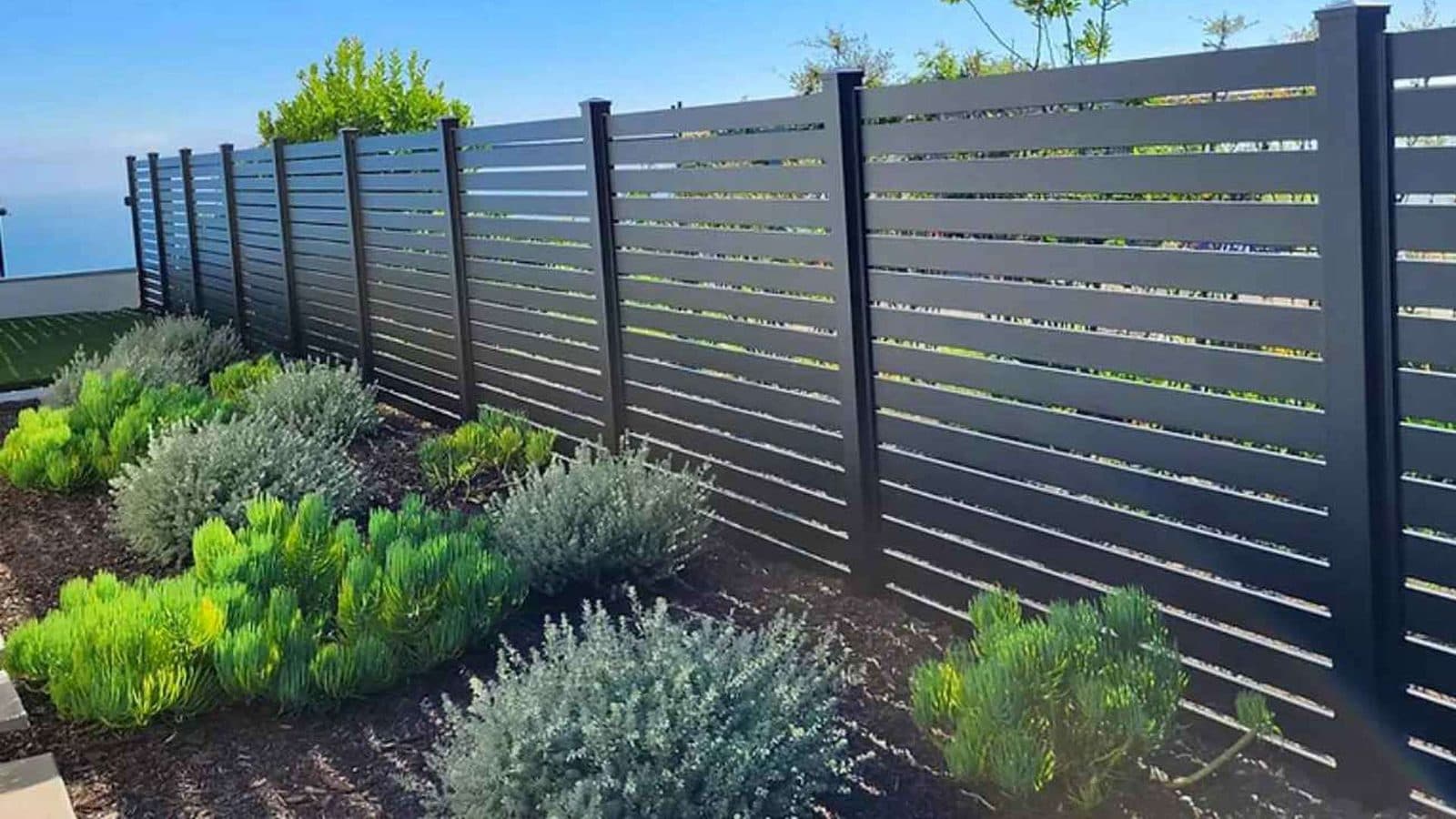
Composite fencing has become the popular alternative to timber: boards that look like wood, never need oiling and are sold in every hardware chain. It is a genuinely good product with a specific weakness, and that weakness is the South East Queensland summer. With storm season starting, this is the comparison worth having before you commit a boundary to one or the other.
The quick answer
Composite is wood fibre and plastic pressed into boards. It looks like timber, never needs painting, and moves with temperature.
Aluminium does not rust, rot, warp or fade appreciably, and moves very little in heat.
Most composite fence systems already use aluminium or steel posts and rails, with composite only as the infill.
Neither needs painting. The difference shows up in full western sun, on long runs and in a storm.
What composite fencing actually is
Composite, sometimes sold as wood plastic composite, is wood fibre mixed with plastic and pressed into boards. The wood content gives it a timber grain and a timber feel. The plastic content is what stops it rotting and what removes the oiling cycle that makes a timber fence hard work.
Very few composite fences are entirely composite. In most systems the posts and the rails are aluminium or steel and the composite boards slot in between them as infill, which tells you something useful: the structural parts of a composite fence are usually metal, because that is what holds a line straight.
The three things a Queensland summer does to a fence
Heat, ultraviolet and storms. Every material on the market answers those three differently, and the honest comparison is one column at a time rather than a winner declared up front. Our wider look at what suits the region is in the best fence for the Queensland climate.
| Composite | Aluminium | |
|---|---|---|
| Movement in heat | Expands and contracts noticeably. Gaps at board ends are specified by the maker for that reason | Moves very little. No expansion gaps designed into the panel |
| Surface temperature in full sun | Gets hot to touch, more so in dark colours | Gets warm. Thin sections shed heat quickly |
| Colour over time | Weathers and lightens, usually most in the first year, and cannot be repainted | Powder coat holds its colour. Can be repainted if you ever want a change |
| Rot, rust and termites | Does not rot or attract termites. Fixings can corrode | Does not rust, rot or warp |
| Damage | Scratches and gouges show and cannot be sanded back like timber | Dents are possible on any metal. Welded blade resists knocks best |
| Weight | Heavier boards, closer supports | Light. Two people handle a full panel |
Heat: the expansion gap nobody mentions in the showroom
A composite board is part plastic, and plastic expands when it gets hot. On a 20 metre boundary facing west that is not a theoretical problem, which is why every composite manufacturer specifies a gap at the end of each board and a fixing method that lets the board move.
Installed correctly, the fence absorbs the movement and you never notice it. Installed tight, with no end gaps, boards bow and push against the posts on the first run of hot days. It is the most common composite fence complaint and it is an installation issue rather than a product fault, but it is a risk that simply does not exist with an aluminium panel.
If you are going composite, ask one question
What is the specified end gap for this board at the length I am running, and what fixing lets it move? If the answer is vague, that is the answer.
Sun: what fading actually looks like
Composite weathers. Most brands lighten over the first year and then hold reasonably steady, and good products are made with that settling built into the colour you are sold. The catch is that the change is not reversible: you cannot repaint composite the way you can repaint timber, so the colour it settles at is the colour you keep.
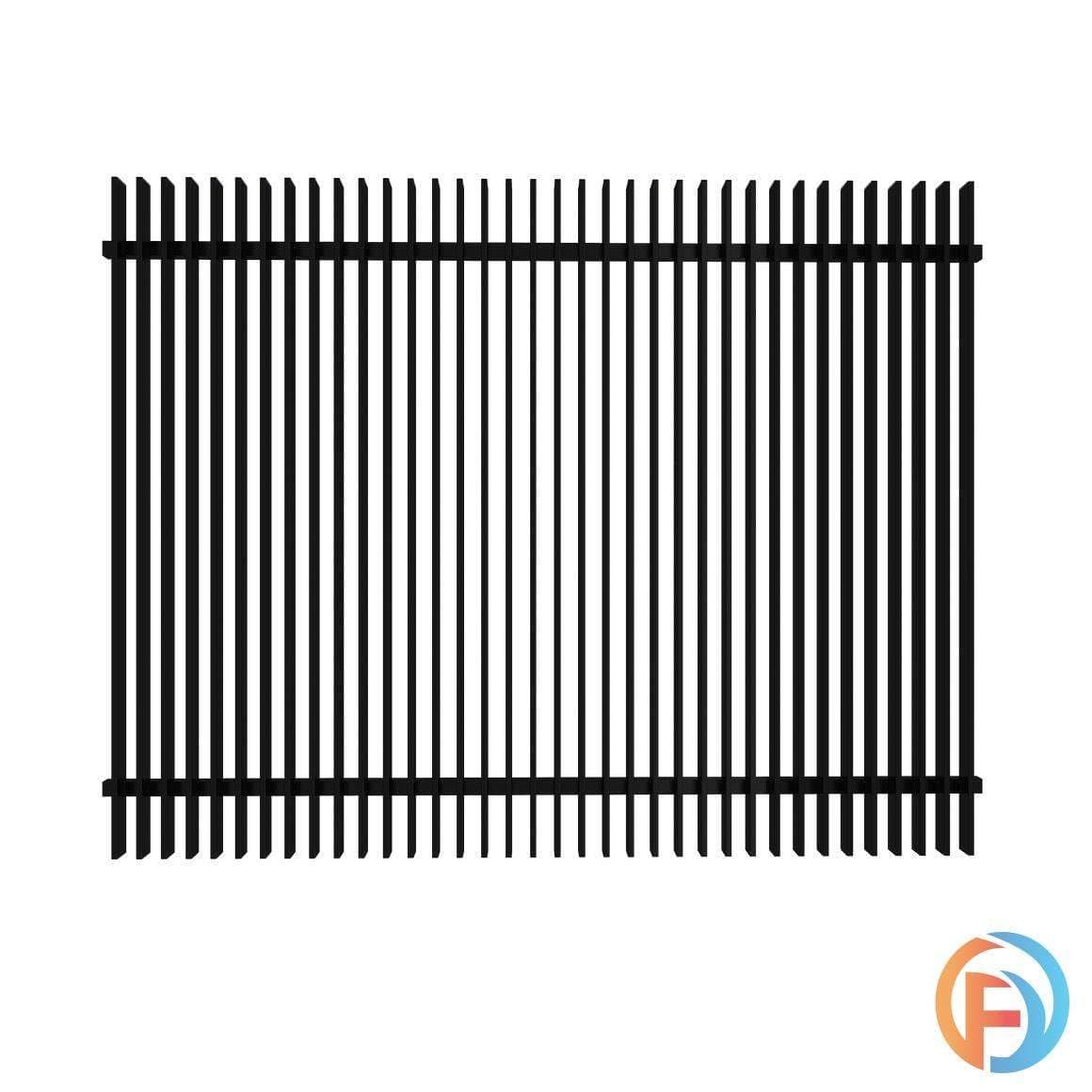
Powder-coated aluminium behaves differently because the colour is a coating rather than the material. FY panels come in Black, Monument and White, the three Colorbond colours that sit against most Brisbane houses, with a 10-year warranty on the aluminium. Why the coating matters more than the metal is covered in what makes a good powder coat.
Storms: what actually fails, and why
A fence rarely fails in the middle of a panel. It fails at the post, at the fixing or at the joint. That is true of every material, which is why storm performance is mostly about how a fence is built rather than what it is made of.
Two things make a difference in a South East Queensland storm. The first is wind load: a solid privacy fence catches the whole gust, while a slat or blade fence with gaps lets some of it through, which is why open profiles tend to survive exposed corners better. That is the reasoning behind our note on fencing windy and exposed sites.
The second is what happens after. Debris hits fences. A dented aluminium panel is replaced one bay at a time from stock profiles in the same colour. A gouged composite board is replaced from whatever that brand still makes in that colour, which is a harder conversation two or three years in. Before the season starts, the checks worth doing on any fence are in our storm season preparation checklist.
Cost, compared honestly
Composite and aluminium sit close together, and both sit above timber and Colorbond. Composite board pricing varies widely between brands and between an infill-only system and a complete kit, so compare the finished metre rather than the board.
For reference, FY aluminium panels start at $279 for a horizontal slat panel, $368 for vertical picket and $399 for welded vertical blade, each 2400mm wide (2350mm in picket). With posts, caps and brackets that lands near $150 a metre supplied. Where that sits against every other material is set out in the cheapest fencing options in Brisbane.
One number that is easy to miss: composite systems that use metal posts and rails mean you are buying metal anyway. At that point the question is narrower than it first looks. It is whether the infill should be a wood-look board or a metal one.
Where composite is the better answer
It would be dishonest to run this comparison without saying where composite wins, so here it is. If you want the warmth and grain of timber without the oiling, nothing metal will give you that. Aluminium can be made to look like many things, but it does not look like wood, and a composite board in a sheltered courtyard or a shaded side boundary will look exactly the way you hoped for years.
Composite also suits a screen rather than a boundary: a short run, out of the worst sun, where the appearance is doing most of the work. What it is less suited to is a long western boundary in full sun, an exposed corner block, or a fence you want to still match itself in fifteen years.
Choosing between them
Pick composite if the timber look is the point, the run is short or sheltered, and you are comfortable following the manufacturer’s expansion and fixing detail exactly.
Pick aluminium if the run is long, in full sun, on an exposed block, or if you want to be able to replace one bay in ten years and have it match.
Either beats timber on upkeep. Both remove the oiling cycle, which is the real reason most people are looking past a paling fence in the first place.
If aluminium is the direction, the panels are made to your measurements at our Slacks Creek yard in Black, Monument or White, supply-only for a DIY install or measured, made and installed. Installation work is led by our founder and director, Kejin Yang, who holds an active QBCC trade contractor licence (no. 15027695) with classes including Structural Landscaping.
Frequently asked questions
Is composite fencing better than aluminium?
Neither is better across the board. Composite gives you a timber look with no oiling, which aluminium cannot do. Aluminium moves less in heat, holds its colour, can be repainted, and is easier to match when one bay needs replacing years later. On a long western boundary or an exposed block, aluminium is the safer choice. In a sheltered courtyard where the timber look matters, composite makes sense.
Does composite fencing expand in the heat?
Yes. It is part plastic, so it expands and contracts with temperature, which is why manufacturers specify an end gap on every board and a fixing method that allows movement. Installed to those instructions it is fine. Installed tight with no end gaps, boards bow on the first run of hot days.
Does composite fencing fade?
Most composite weathers and lightens, usually most in the first year, then holds more steadily. Quality brands account for that in the colour they sell you. The difference from timber is that it cannot be repainted, so the settled colour is permanent. Powder-coated aluminium holds its colour and can be recoated if you ever want a change.
Which fence survives a storm better?
Fences fail at posts, fixings and joints rather than in the middle of a panel, so how it is built matters more than what it is made of. Two things help: an open profile with gaps lets wind through instead of catching the full gust, and a material you can still buy in your colour makes repairs after the season straightforward.
Is composite fencing cheaper than aluminium?
They sit close, and both sit above timber and Colorbond. Composite pricing varies a lot between brands and between an infill-only system and a complete kit, so compare the finished metre rather than the board. Remember that many composite systems use aluminium or steel posts and rails, so part of the metal cost is in both quotes.
Can composite fencing be used as a pool fence?
We cannot advise on that, because we do not supply pool-safety barriers and our own fencing is not sold or certified as pool-compliant. Any pool barrier has to meet the Queensland pool safety standard, and that is a question for a licensed pool safety inspector.
What maintenance does aluminium fencing need?
Washing. It does not rust, rot or warp, and there is no repainting cycle. A hose down a couple of times a year, more often on a coastal boundary where salt settles on the coating, is the whole routine, and there is a 10-year warranty on the aluminium.
General guidance only. Composite products vary widely between brands, and expansion gaps, fixings and support spacing are set by each manufacturer. Follow the instructions that come with the product you buy.
Working out what your fence line needs? Tell us the run and the height and we will quote it, supply-only or installed.
- Brisbane-based supplier
- Aluminium fencing & gates
- Supply or installed